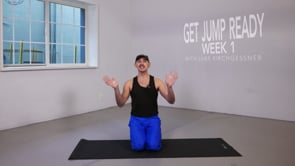
Begin your 4 week foundational jump journey here. This class focuses on helping you find your axis and build a taller, more supported position in your jumps.
It’s a great starting point for beginners who want to feel more prepared and secure taking jumps onto the ice, and a valuable reset for skaters looking to refine and deepen their understanding.
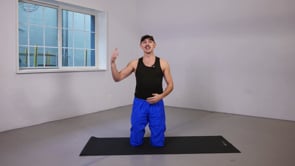
(The "Laser Beam"): This foundational exercise introduces the concept of a vertical "laser beam" that extends from the top of the head down through the trunk and out through the feet.
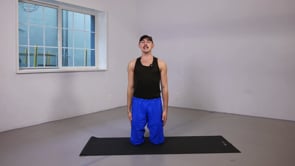
This exercise involves intentionally tipping the body slightly away from the established vertical axis line to practice returning to a balanced center.
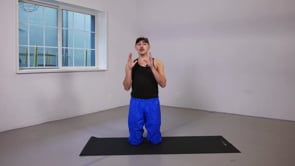
Performed while kneeling, this exercise requires moving the body in a circular "orbit" around the imagined central axis line, often with eyes closed to enhance physical awareness
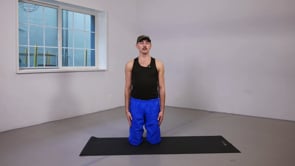
While maintaining the vertical axis, the skater practices turning their head to the side without allowing the head's movement to pull the rest of the body off the central line.
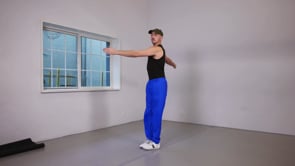
This exercise helps you find and maintain a tall, stable axis line from head to feet while gently tipping forward, backward, and side to side. As you rotate or walk in a circle, vary your arm positions (anchor arm in front, square, or opposing) while keeping ribs in and chest neutral; try closing your eyes to better feel your “laser beam” axis.
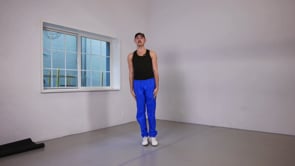
This exercise helps you feel a fixed central axis by imagining a “laser beam” through your body as you circle (orbit) around it; perform the movement in both directions to explore the axis from different angles.
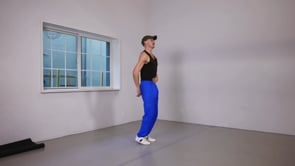
This exercise builds awareness of a tall, stable axis through small, quick rebounds on the balls of the feet, keeping the knees soft and the body upright (no hinging or deep squat). Move around a circle while keeping the head aligned with the chest, and progress by closing the eyes to better maintain your axis line.
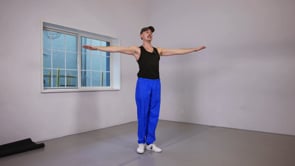
Start with arms held square out to the sides, ensuring shoulders are not rotated in either direction. While maintaining a single spot on the floor, rotate in both directions. For increased difficulty and awareness of the "laser beam" axis, perform this exercise with eyes closed.
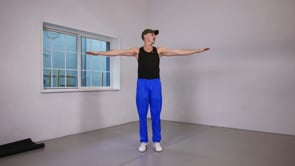
Maintain a tall, flat posture with ribs tucked in while walking in a circle. Start with arms in a traditional rotating position (one arm in front, one behind), then transition to a square shape, and finally move the arms in the opposite direction, all while keeping eyes closed. The goal is to keep the internal axis line strong regardless of arm position.
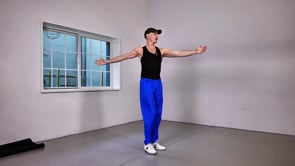
Maintain a tall, flat posture with ribs tucked in while walking in a circle. Start with arms in a traditional rotating position (one arm in front, one behind), then transition to a square shape, and finally move the arms in the opposite direction, all while keeping eyes closed. The goal is to keep the internal axis line strong regardless of arm position.
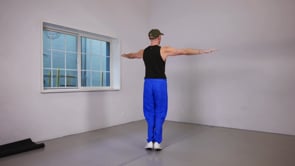
Perform quarter-turn jumps with very little to no knee bend, focusing on rotating while keeping the arms in a square position. This exercise is performed with eyes open and then closed, first with square arms and then with arms positioned against the direction of rotation to map out the turns.
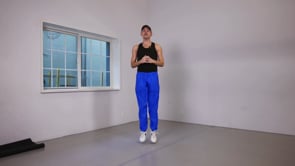
Utilizing a rhythm like a small trampoline, perform soft, continuous hops on the balls of the feet while maintaining a tall posture. Progress to moving in a full circle with quick bounces, keeping the head aligned with the chest rather than turning it independently.
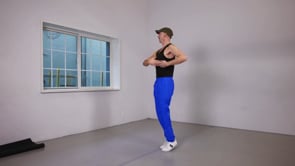
While hopping, practice tapping the lower ribs (closing the position) and then opening them back up. This exercise builds an understanding of how changing the body's shape in the air affects rotation speed while maintaining the internal axis.
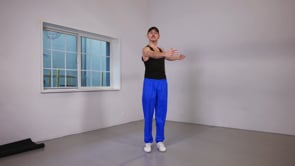
Perform quarter-turn hops while holding the arms in a "wind-up" position against the direction of rotation. Focus on keeping the shoulders relatively square and the lower ribs tucked into the body to avoid excessive twisting or breaking the axis.
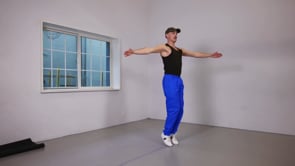
A challenging variation where the arms are positioned "into the wind" or in the same direction as the rotation, which is contrary to standard skating checks. This experimental drill forces the skater to maintain a strong axis line and avoid leaning even when the arms are on the "wrong" side of the body, and it is performed with eyes closed for maximum difficulty.
